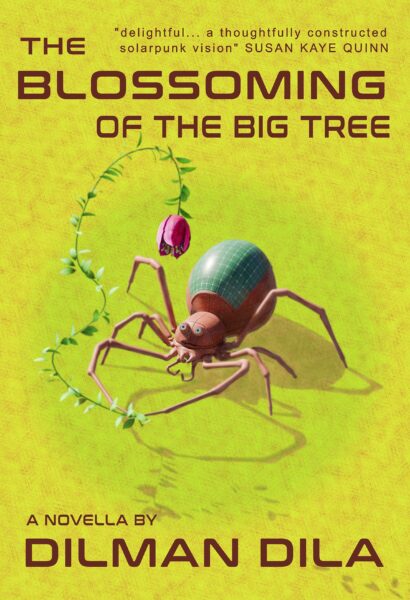
The Blossoming of the Big Tree
Dilman Dila
Novella | 34k words | 115 pages
Genres: Science Fiction | Solarpunk

Release Date: 1 Aug 2026:
Pre-Order
US $9 | UGX 30k
Shipping Rates
These rates are estimated, and may change even after you have made the purchase.
Delivery within Kampala/Uganda depends on your location. Upon purchase, we shall call to arrange for it.
International Shipping Rates
Europe: $9
East Africa: $6
West Africa: $7
USA*: $50 (via courier)
North America: $12
Asia: (still calculating, about $10)
Australia: (still calculating, about $10)
South America: (still calculating, about $12)
*Please note that there are general postal restrictions to the USA, so it is costly to post anything there.
Release Date: 1 Jan 2027:
Pre-Order
US $10 | UGX 30k
Bundles coming soon, once the other formats are available.

Price: $7.00
Price: $7.00
.mobi .epub .pdf
Price: $10.00
AudioBook $10
Pre-Order
.mp3
Blurb
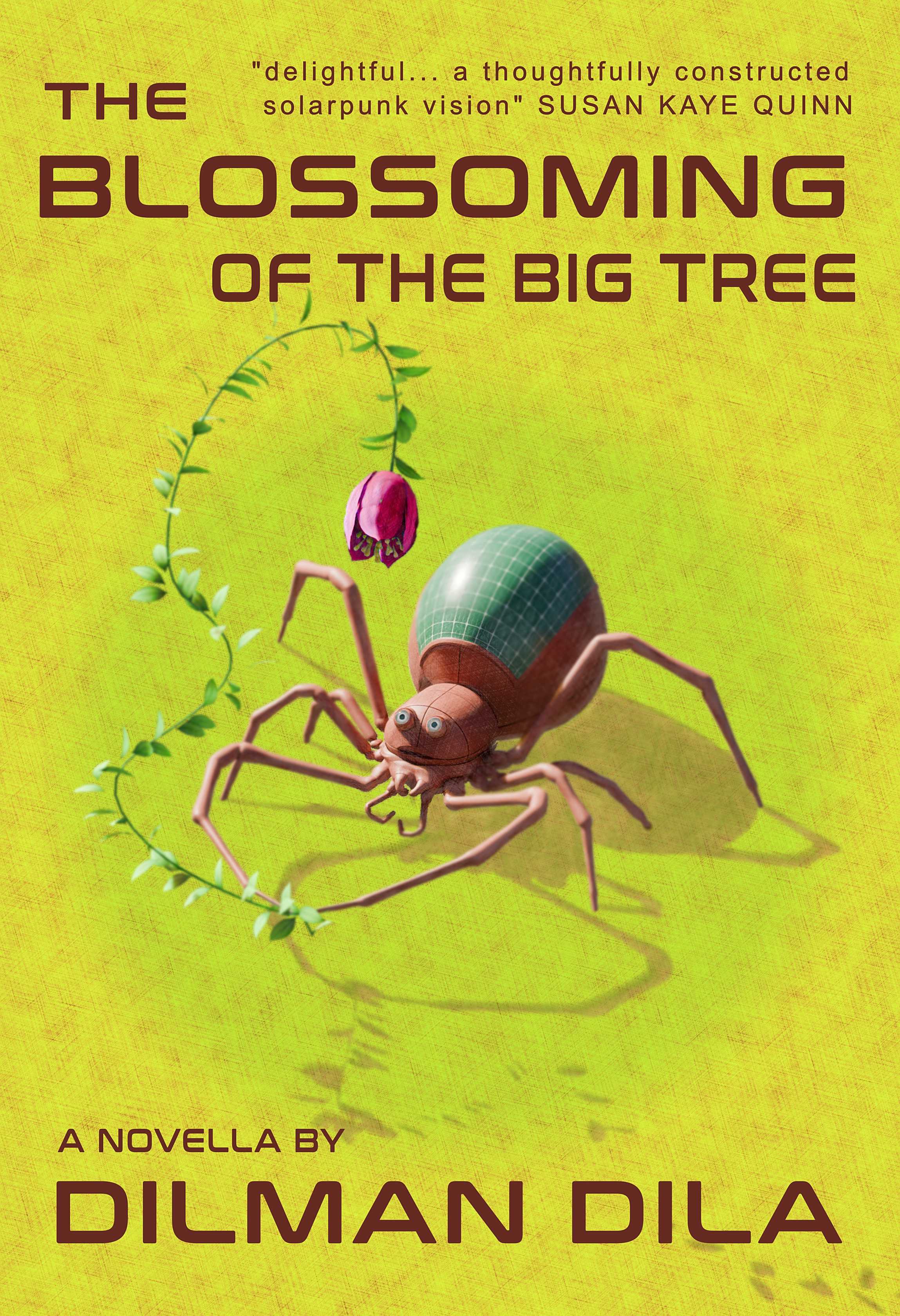
An old woman has to coordinate the defense of her decentralized African country, when a colonizer invades to steal the technology that makes them a solarpunk utopia.
Product Details
Publisher Ododo Press
Publish Date 1st July 2026
Pages About 152 pages
Word Count About 33,000
Language English
Type e-book, AudioBook, Print
ISBN: 9789970246991, e-ISBN: 9798233951169, kobo: 1230009751668
Categories: Science Fiction, Solarpunk,
About the Author
Dilman Dila is a writer and filmmaker. His books include Where Rivers Go To Die, which was shortlisted for the Philip K Dick Awards (2024), and The Future God of Love. He was shortlisted for the BSFA Awards (2021), the Nommo Awards for Best Novella (2021), and the Commonwealth Short Story Prize (2013), among many accolades. His short fiction appeared in The Best Science Fiction of the Year: Volume Six, and in The Best of World SF V.2, among many anthologies. His films have won multiple awards. For more of his life and works, visit www.dilmandila.com
ADITA LOVED TO lie in the grass, daydreaming as she watched clouds twirling and morphing into fanciful shapes, but that morning she glared at the sky. She had forgotten to charge her tractor. No. Not forgot. Rwot duty had kept her too busy. The tractor needed an hour of strong sunlight, but the rain-makers warned that the clouds would wrap her village in gloom all day, perhaps all week. To plough, she had to pedal.
Kolo!
Her knees throbbed with a false pain, urging her to borrow a battery from a neighbour. She looked toward the homestead of the nearest, Omita, about a hundred meters away. Dew glistened on leaves like tears that spirits had forgotten to wipe off, and the mist lingered like their bad breath. His huts lurked behind the tall grass like monsters waiting to eat her. There were about ten in his courtyard, some three stories high, all with mud-brown walls and green rooftops that gleamed like wet foliage. They dwarfed her huts, which were closer to the peasant shelters she had grown up in, for she lived with only five other people, her pre-teen grandchildren. Palm trees stood stiff around her home, like sculptures of ghouls waiting to pounce on her the moment she stepped out of her compound. She sighed. Omita, an amiable father of nine, would insist on sharing a cup of porridge and gossip before lending her the battery. Amollo, the neighbour to her left, with about twenty huts and over fifty people in her homestead, would invite her to snack on roasted groundnuts, and then narrate the entire plot of whatever silly TV drama she drowned in every evening. The other neighbour, Ogwapus, too far for her to see their homestead, would insist on bringing their own tractor to plough her garden himself, then settle for a calabash of beer and loiter in her compound until evening. Kolo! Her bones might be seventy years old, but they could still pedal. Instead of thirty minutes with a battery, it would take three hours to plough, perhaps five since she lacked the strength of youth. It would be a good excuse to stay away from her vidisimu. Oh, I was in the garden and didn’t hear it ring, was it anything urgent? No, of course no call was ever that urgent.
A temptation nearly overcame her to plug the tractor into a wall-outlet. Don’t! It would drain the pokpot solar panels, which were made from a paste of leaves and algae. In weak daylight, they had a very low capacity to generate electricity via photosynthesis. In the night, they released the stored energy to power her homestead. If the clouds hid the sun for three months, they would use up all their proteins and die. Then, she would endure the month-long process of manufacturing new panels, with strong and bright sunshine being the only guarantee for success, and, in that time, how would she cook?
Kolo!
She trudged back into the storage hut and straddled the tractor, which had the frame of a bicycle, but with six long and spindly legs instead of wheels, and with a box-shaped trailer, which housed an engine and had solar stone-slats on top and a plough at the bottom. She flipped a switch from Power to Pedal, gripped the handlebars, pulled a lever, and the legs stretched, lifting her ten feet above the ground. She eased it out of the hut and walked it to her garden, only twenty meters away, but it knocked the wind out of her chest. Kolo! Just go to the neighbours! They had larger families and bigger gardens, and a lot of spare batteries since they had the labour to manufacture them, but they also had very loose mouths and very nosy noses. She gritted her teeth, engaged the plough gear, and now when she pedalled, her legs were heavier than iron bars.
The garden, about an acre large, had two stories. The ‘upper floor’ was twenty feet high, and was merely rows of pots hanging on poles, growing beans. She wanted to plant potatoes on the ground-level, but it was overgrown. Kolo! Her grandfather had dug his garden with bare hands and a hoe, though he had been about the age she was now, but her generation had become lazy because of machines. Pedalling is good exercise!
She huffed and puffed but twenty minutes later she had cleared only ten meters. Sweat filled her wrinkles and her knees screamed. She again looked toward her neighbours… Nope! She had to recover from yesterday’s meeting, which had lasted fifteen hours. She had talked, and talked, and then eaten with other people and even shared a calabash of kongo with them, though their odours suffocated her. It was an argument over who should contribute most to a wedding party due in six days, and so Adita, being rwot, had to help find a consensus. When she returned home long after sunset, her mouth was full of sand and salt, crickets shrieked in her ears, and the fingers of other people crawled on her skin like maggots. She needed today to herself.
Why did I accept to be rwot?
The disc blades of the plough sunk into the ground. She huffed and pedalled. Sweat drenched her clothes as if she had fallen into a river. Her life would have been easier if she allowed adults to live in her homestead. They would have helped with this kind of work. Kolo! Why am I like this? She stopped, and again glanced at the neighbours, the solar pastes on their roofs gleaming like beacons, and it was a mystery to her why she could not just walk over to borrow a battery.
Something in the periphery of her vision distracted her. She turned to see a bruka, painted in the colours of a leopard, flapping its wings as it raced to her home.
“Kolo!” She spat. Let me work my garden in peace!
The pilot was Ogen, a lawang rwot, technically her deputy but so full of indecision that she wondered why they nominated him. Oh, she could not understand why they picked her either! Perhaps the person who suggested her name wanted to punish her with the most tedious job in the village. Until recently, people campaigned for leadership positions, but this threatened to nurture the kind of corruption that Yat Madit had replaced. Being rwot had no material benefits and no social influence beyond the village, but some people rewarded themselves by robbing the collective stores, or making others to work for them. So someone proposed a law banning rwot from these communal services, and forbidding campaigns. Instead, citizens nominated candidates and the village reached a consensus on who should lead. The chosen person could not refuse, unless they had health issues that would make it hard for them to perform their duties. Adita for a moment thought it was a good thing to be rwot. The job gave her an excuse to meet people regularly without engaging in small-talk, or discussing melodramatic series over calabashes of beer. Then, no one would ask her that disturbing question; Why are you always alone? No one would think of banishing her because she did not enjoy the company of other people.
The ornithopter hovered above her homestead for a few moments, then the pilot saw her, and landed a few feet away. It was a small craft, a little bigger than the motorcycle her father had ridden. Some called it a flying bike for, like the tractor, it used the frame of a bicycle, though it was encased in an oval-shaped body and had bird-like wings on top. Ogen flipped open its single door, but did not get out.
“Thank you,” he said in greeting.
“I’m busy,” she said. “Whatever it is, handle it.”
“You didn’t wake up very well,” he said, grinning.
“When do I get to work my garden if I spend all my time on rwot duty?”
“Isn’t there someone to help you?”
No! The retort stuck in her throat. If she lived with a large family, the young people would do the hard work while old people like her sipped beer all day. But after her husband had died, about ten years ago, she left his homestead and settled here, with the excuse that she could only overcome her grief by moving to a new home. For company, she got her pre-teen grand children to live with her during school, and they would return to their parents during holidays.
“You are my deputy,” she said. “Handle whatever it is.”
“A gengo person,” he said.
She bit her lips to stifle the growing anger and tried to keep a friendly voice. She even smiled. As rwot, she merely chaired the committee that governed the village, but in delicate issues, like brides throwing tantrums over their weddings, or people on gengo, she had to participate in the decisions of the committee. It was just bad luck that for two days in a row things came up that demanded her presence, forcing her to endure the company of others. Still, she tried to avoid it.
“The guidelines are clear,” she said. “If he’s blocked from his village, he can’t stay here.”
“He’s been here for three days already,” he said.
“Three days!” The words burst out of her mouth like fire out of a flamethrower.
“His mother tried to hide him…” he trailed off.
If word got out that her village, Rac Koko, had hosted a person on gengo, the federation might block them as well. Then, in crisis, like when the clouds hid the sun for so long that all their batteries ran out, villages in sunny places would not help them to recharge. They were largely self-sufficient with enough food in their granaries to last about five years, but a gengo would deny them essentials they could not produce, like salt, or delicacies they had to import, like avocado, fenne, and gonja. And citizens of Rac Koko would be barred from festivities in other villages, and they would not be able to download new melodramas and music, or to enjoy the social media feeds from anywhere in the federation.
“What did he do?” she asked.
“He beat his wife,” he said.
Oi, she cried. The most heinous reason to gengo! Hosting such a person might get her village blocked for two years as punishment.
“Is it Okong?” she asked.
“Yes,” he said. “It’s him. His mother hid him, but his sister reported him.”
Okong had been in the news about a month ago, after his village, about two hundred miles to the north, had banished him to the bush for beating his wife. He escaped and word had reached them that he might come to Rac Koko, where he had grown up, and so vigilantes were on the lookout. In the past, he might have sneaked into a city and disappeared among the massive populations, but the Yat Madit revolution triggered migration to rural areas after villages got all the luxuries of the cities, but without the poverty. Now everyone knew everyone else in the neighbourhood, and a stranger appearing out of the blue, especially with a gengo alert out, would draw a lot of questions.
“Stay here,” she said. “Help clear my garden.” It was okay for her to ask another leader to help her with work.
“How will you fly to the Centre?” he said.
Good question. Her father had tried teaching her to ride his bodaboda, but she daydreamed too much to keep the motorcycle balanced. Then the Yat Madit revolution happened and suddenly her village was full of machines, all manufactured locally using 3D printers, so she took flying lessons on the new ornithopters. Still, the daydreams made her absent-minded. She could ride the tractor, though, for it required physical energy, which kept her focused.
She pedalled out of the garden but left the tractor outside in case the rain-makers were wrong and the sun returned.
Her compound had four huts. She lived in the largest with her grandchildren. To its left was the only multi-storied structure in the courtyard, with three floors. She stored tools on the ground section and had granaries in the upper levels. Behind it was an enclosure for her goats, and behind that a composting toilet, which was an improvement from the pit latrines of her childhood for they did not have an odour. The kitchen stood to the right of the main hut, and the smallest hut was the bath-hut, which was behind the kitchen for it used the same water recycling system. Though the village had not yet experienced drought, they learned to conserve water.
She stayed longer than usual in the bath, as though that would make the problem go away, as though to prepare her body for another long day of contact with people. Then, she discarded her work overalls for a formal dress with pointy shoulders, a cross between a t-shirt and a gomesi, which she wore in all rwot meetings.
She gave the children breakfast, instructed them to go straight to school after eating, then climbed onto Ogen’s bruka. There being only one door, she went in first and took the back seat. His sweat stung her nose, but the space, though cramped, was thankfully large enough for her to avoid skin contact. In a minute they were up in the air, the village sprawling beneath them. A blue road snaked around the homesteads, twisting and turning, with other roads branching off randomly, creating a chaotic design. There was no main road, unlike in her childhood where streets were straight and arranged in grids, since, without a central planning office, people built wherever they wanted, creating a maze that, surprisingly, morphed into a spiral fractal beauty.
In her childhood, the Centre of the village was a collection of makeshift market stalls in front of small retail shops that straddled a dirt road. The buildings had red brick walls and rusty iron-sheet roofs, and the vegetation was always red with dust. Now, the road was blue with solar-stone-slats to power their buses, and the buildings were much taller, with some being seven stories high. They were made with wood and mud, and were cylindrical rather than rectangular, and they housed schools, a hospital, an indoor theatre and social centre, the collective store, and the 3D printer. They encircled an open space, about the size of a football field, which they called wang oo. A very big tree stood in the middle of wang oo, it had served as their meeting place since their first ancestors settled here, about a thousand years ago. During the full moon they danced in wang oo, and during harvest festivities people came from far away for religious rituals. The tree was the Village Council’s meeting hall. Cameras hung on branches to broadcast sessions to all citizens, and most people followed the boring proceedings on their vidisimu. But that morning, Adita found a large crowd of about a hundred people waiting.
All twenty members of the Village Council sat in a circle, on three-legged stools, and the crowd stood around them. She had brought her own stool, and the moment she joined the circle, the councillor in charge of the police spoke. He had no uniform, and no weapon. He was ‘police’ only because he had to coordinate the enforcement of any decisions on criminal matters.
“Rwot is here, so let’s begin,” he said. “This is a wife beater. He can’t stay. We must throw him into the bush. But we have to discuss his mother for hiding him.”
Okong sat on the ground with his hands and legs tied, his eyes wet with a plea. She had known him when he was a jolly boy. His mother sat behind him, the plea in her eyes too. A long time ago Adita regarded her as a friend, and now they exchanged nods in greeting. How could she exile a man who called her aunty because his mother considered her a best friend? It had been a few years since they had last talked. They never fell out, but Adita had a hobby of dodging people who came too close to her. Now, she could read the plea in this old friend. Don’t send me to the bush. You might end up there yourself, since you like being alone.
“Where shall we send him?” Adita said, and at once she bit her lips hard as though that would recall the words. Am I sympathizing with them? An angry murmur rippled through the crowd as though in response to her unspoken question.
“Are you suggesting we keep him here?” a councillor said.
“No,” Adita said, her voice trembled as she grasped for a way out of the blunder. “We – we must gengo him, b-but is there a chance of reconciliation? Should we send him to the bush, or back to his village if his wife is open to reconciliation? That is what I meant.”
She could not convince even herself. In her childhood, when men went to jail for domestic violence, the family would pressure the wife to forgive him. But now, the village would pressure her to divorce him, and not to accept any reconciliation rituals until after he spends a year in the bush like a wild animal. This view evolved after the person whose inventions sparked off their revolution, Lokang, made en technology free only to communities that shunned violence. As people relied more on the vidisimu, en bombarded them with media that taught them to despise men who beat their wives. Eventually it sunk into the general consciousness that the only way to punish such people was to expel them into the wild.
“I’ve changed,” Okong said. “I swear! Please let me plead with my wife!”
“Please,” his mother said. “You all grew up with him.”
“You’ll go to the bush with him,” another councillor said. “How can you hide a wild animal in your house?”
Adita’s vidisimu bleeped, sharp cries like the police sirens in her childhood. Kolo! She already had a major crisis in her village, and now another was unfolding at the national level?
“I can’t ignore this,” she said to the council.
A needless explanation since she chaired the National Committee for Defence. That ringtone was in every vidisimu because anyone could become rwot and serve in any of the national committees. It went off only in catastrophic events that threatened dozens of villages.
She stepped away from the tree and accepted the call. It came from a man called Hamid, the committee’s secretary. He was about two thousand miles away in what used to be in southern Tanzania. Even after all these years, she oriented herself by placing people in their old countries. Hamid’s village was now in the region that they thought of as ‘the central belt’ of the federation.
“We are under attack,” he said.
“Eh?” she said.
“They invaded us twenty minutes ago.”
“What are you talking about?”
“Kenya!”
“Kenya?”
“And USA. Their warships are heading for Kinshasa.”
She gaped, unable to respond. At nineteen years old, she had wanted to become a soldier like her mother, but failed the recruitment interviews because of her height. So a year after she became rwot, since, on top of leading the village she had to serve in a national committee, she volunteered for Defence, though ‘defence’ was only in word. Her biggest responsibilities was to oversee discussions about responses to disasters. She did not physically meet with other national committee members, which was really nice, and every village had a well-trained team to manage crises, which made her job easier. Her committee would find the teams closest to the disaster, see what they needed, and figure out the nearest place to find supplies. The only part of the job that vaguely resembled defence was sending food aid to Kenya, which was still under a dictator. There was no sign at all that the job would involve war. No one wanted it. After two nuclear conflicts in the global North, there was a strong international push for peace. But war had come, and now she realized who exactly she was. Minister of Defence. Without the fanfare such ministers enjoyed in other countries, without a platoon of bodyguards, without even an actual army and without any weapons, but still a minister of defence.
Kolo!
“What?” Hamid said.
Did I speak aloud? She used Acholi which the vidisimu translated into Kiswahili for Hamid, but she had uttered a slang word that wasn’t yet in the system. Only a few people in her village swore that way, and so the translator gave Hamid all three formal interpretations. A mat. Anger. A troublesome person.
“We are meeting in fifteen minutes,” Hamid added.
You have to solve the crisis. She could read it in the way his lips trembled. He was a tailor. Most likely, he too never thought of himself as a powerful person in a ministry of defence, but now that burden rested on them. On her.
“I have a crisis in my village,” she said. “A gengo person.”
“Oh that’s bad,” he said, and seemed not to know what to say next.
What should she prioritize, saving her village from getting blocked, or her country from invasion? But, her village was her country, one of the hundreds of thousands that formed a federation. When still a child, her village did not feel part of the nation for the government largely ignored them in favour of big towns and cities. Only during elections would they be reminded that they were in a place called Uganda. The revolution ensured the village was what it had always been, a state within the state. Perhaps if they did not get involved, the invaders would not bother coming this far up North. Perhaps…
“What do they want?”
“Who knows,” Hamid said. “We give the Kenyans food. We give the Americans minerals. So who knows why they attacked.”
When the Yat Madit revolution started, as the vidisimu inspired people to get rid of dictators and central governments, Kenya banned the technology. The corporations that ruled the US had their African headquarters in Nairobi, and they influenced the Army to shoot thousands of protesters to death, stopping the revolution in the country. As the federation prospered into one of the few countries standing on their own against the climate crisis, Kenya descended deeper into poverty and oppression. A thirty-year-long drought worsened the situation. Kenya never openly threatened to invade and steal food, but that possibility hung in the air because it was under a dictatorship, and so, as a deterrent, the federation had defence pacts with other countries. They also fed about a third of the Kenyan population, and that aid was a kind of bribe to keep the hungry soldiers on a leash.
And they gave American corporations minerals. They used pito nyonyo to grow any metal in a process no more costly than farming, making it easy to bribe the US and even its rivals, China and Europe, to ensure Kenya never attacked them.
Yet, it had happened.
Each village in the federation had an ‘army’, each independent of the other, but they were not military in the real sense. They did not have full-time soldiers and they had no weapons. They were volunteers trained to respond to the climate crisis. Floods, droughts, wildfires, freak storms, someone had to clean up, someone had to help those who were forced to flee from their villages, someone had to ensure that life continued, and that someone called themselves a soldier. How naive! Without an actual army, but with a lot of food in their granaries and a lot of resources and secret technology like pito nyonyo, it was only a matter of time before the greedy attacked.
“We are meeting in fifteen minutes,” Hamid said again.
Adita ended the call without another word, and returned to the tree, where the discussion was heated, for the friends of Okong’s mother were defending her. She was not a bad woman. She should not be banished to the bush for acting like a mother.
“Things are bad,” she said.
“Not as bad as this,” a councilor said. “We must throw them both out.”
“Kenya invaded,” she said.
Nobody seemed to know how to respond. Some people made noises she could not understand. Grunts? Squeaks of terror? Were they just clearing their throats? They looked at her as if they were at a wedding and she had announced that there would be no food or beer.
“Even America,” she added. “Their warships are heading to Kinshasa.”
“Why?” several people chorused.
She pirouetted and walked away without another word, leaving a stunned silence behind. Ogen, without being asked, followed to fly her back home.
“…a genuinely absorbing read, funny and serious in equal measure, and Adita is one of the most quietly original protagonists I have encountered in the genre in some time.”
Kemi Cole, in Vector-BSFA
“…delightful — wonderful worldbuilding with a thoughtfully-constructed solarpunk vision as well as a compelling story that hooks you in!”
Susan Kaye Quinn
Author of “When You Had Power” and “Halfway to Better”
“This was a very interesting novella. Science fiction that presents a new world always is… All in all: If Dilman Dila’s goal was to create an interesting and engaging world, then he definitely succeeded.”
LimFic
“I enjoyed this novella. It has a delightful and satisfying ending, a main character that I wholly enjoyed meeting, and a lot of different points for discussion if read as a group.”
Holly’s Reading Escapades
“There’s a sense in which The Blossoming of the Big Tree resembles classic hard SF, except this time it’s about finding a creative solution to a puzzle of political theory instead of rocket science. Just like in the pulp novels of old, we’re given the measure of the problem, the type of resources at hand, and the urgent stakes in play, and then we watch smart characters reason their way out of an impossible scenario. So the plot proceeds almost like a thought experiment, a proof by example so cleverly constructed that its logical conclusion feels inevitable in hindsight.
Nerd Coefficient: 8/10″
Nerds of a Feather
Hugo and Ignite Award Winner
“An energetic and immersive window into Dilman Dila’s Afrofuturistic Yat Madit universe, blending cutting‑edge tech with deep‑rooted tradition. The Blossoming of the Big Tree confronts equality with fearlessness, as spybots hum across a world as visionary as it is unsettling.”
Eugen Bacon
Solstice, British Fantasy, Locus and Ignyte Award winner and Philip K. Dick Award finalist
Not yet available.
not yet available
Similar Books

eBook $7
Pre-Order
.mobi .epub .pdf
Price: $7.00