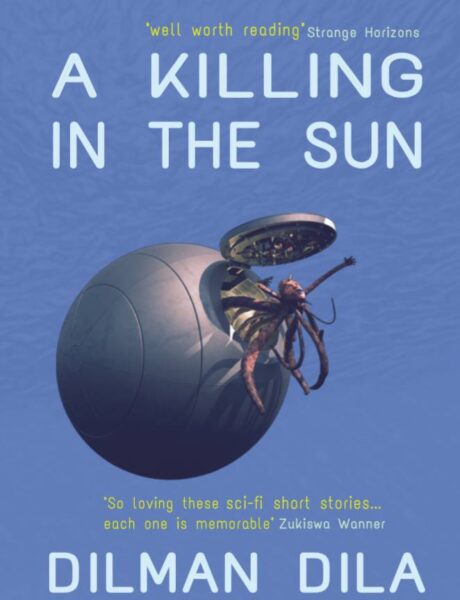
A Killing in the Sun
Dilman Dila
Short Story Collection
60k words | 200 pages
Genres: Science Fiction | Fantasy | Horror
Short Story Collection | 60k words | 200 pages
Genres: Science Fiction | Fantasy | Horror

Release Date: 1 Sept 2026:
Pre-Order
US $12 | UGX 30k
Shipping Rates
Shipping Rates
These rates are estimated, and may change even after you have made the purchase.
Delivery within Kampala/Uganda depends on your location. Upon purchase, we shall call to arrange for it.
International Shipping Rates
Europe: $9
East Africa: $6
West Africa: $7
USA*: $50 (via courier)
North America: $12
Asia: (still calculating, about $10)
Australia: (still calculating, about $10)
South America: (still calculating, about $12)
*Please note that there are general postal restrictions to the USA, so it is costly to post anything there.
Release Date: 1 Feb 2027:
Pre-Order
US $10 | UGX 30k
Bundles coming soon, once the other formats are available.
Price: $7.00
.mobi .epub .pdf
Price: $10.00
AudioBook $10
Pre-Order
.mp3
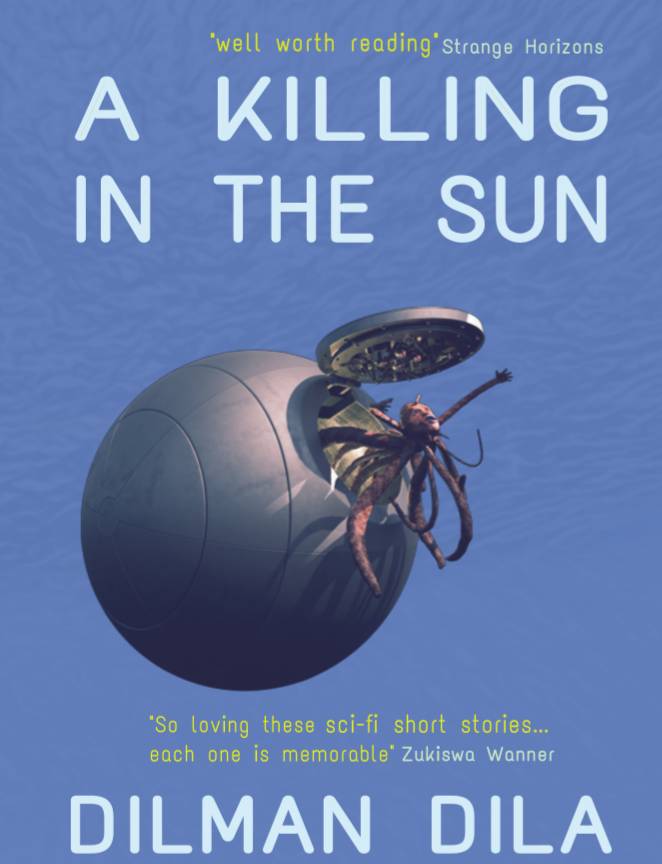
Blurb
A collection of short speculative fiction stories covering all genres. Building on the author’s penchant for the magical, fantastical, and horrific, this collection features stories that are set in a futuristic Africa, or in the present day, with refugee aliens from outer space, a rebellious child eager to inherit their father’s reputation as an assassin, an evil scientist stalking a village, and a greedy corporation creating an apocalypses. There are tales of reincarnation and of the walking dead, and alternative worlds whose themes any reader will identify with.
Product Details
Publisher Ododo Press
Publish Date 1st Sept 2026
First Published 1st Sept 2014
Pages About 200 pages
Word Count About 60,000
Language English
Type e-book (pdf, epub, mobi), AudioBook (mp3), Print (paperback)
ISBN: 9789970246922, e-ISBN: 9798235809567, kobo: 1230010099926
Categories: Science Fiction, Horror, Fantasy,
About the Author
Dilman Dila is a writer and filmmaker. His books include Where Rivers Go To Die, which was shortlisted for the Philip K Dick Awards (2024), and The Future God of Love. He was shortlisted for the BSFA Awards (2021), the Nommo Awards for Best Novella (2021), and the Commonwealth Short Story Prize (2013), among many accolades. His short fiction appeared in The Best Science Fiction of the Year: Volume Six, and in The Best of World SF V.2, among many anthologies. His films have won multiple awards. For more of his life and works, visit www.dilmandila.com
Japia and a two year old boy were starving under an orange grove. He could get food in Abedo, just a mile away, but everyone in that town was dead. If he went there, he would see the rotting corpses of people he had grown up with, of his neighbors, of his friends, of his loved ones. But if he did not go he would watch the child die of hunger. They had last eaten two days ago. Now the boy was too weak to cry. Japia did not know his name.
They had enough water. A red brick house with green iron-sheet roofing stood at the edge of the orchard. It belonged to a wealthy farmer, Opata, who owned the acre of oranges. His family had fled the morning Miss Doe attacked, not knowing that the best place to hide was right in their backyard. Japia had found food in their kitchen. Now, it had run out. They would not be lacking water anytime soon, though, for the house had a rainwater catchment system with a ten thousand liter tank under the ground.
He wondered if Opata’s family had made it to safety. They had a new van, and the roads were smooth enough for them to speed away. He dreamt about his own family every night. He did not know if they escaped the bloodbath. He did not want to find out. He feared if he did, and it turned out to be a horror, he would lose the little strength he had to survive. It was better to imagine that they had escaped.
He had to go to Abedo.
He put the boy in a kasero, a large basket used for keeping chicken, and secured the lid to ensure the boy does not crawl out. He then shoved the basket into the makeshift hut he had built in the grove, using plywood and grass. It did not bother him that he was caging a child like an animal. The scent of oranges protected them from Miss Doe. He had stayed with the boy every minute since they took refuge in the orchard, watching him, making sure he did not crawl out. Now that he had to ride to Abedo, a cage was the only way to ensure the child did not wander away from the grove.
He cloaked his body in orange leaves from head to toe. He piled a lot more leaves onto his bicycle such that he looked like a moving shrub. Then, he stepped out of the grove. Opata’s house was a little over a hundred meters away. It was black, for Miss Doe sat on every inch of the walls and on the roof. Unlike her natural predecessor the anopheles, whose sight was limited to about ten feet, Miss Doe had the eyes of an eagle. She could spot prey a mile away. The moment he emerged from the orchard, she saw him. At once, a cloud rose, like a veil being lifted off the house, revealing the bright green roof, the bright red brick walls, the bright yellow window frames. She floated in small clouds above the rooftop like whiffs of black smoke, and waited for him. She could not attack for the aroma of oranges repelled her.
He rolled his bicycle to the house. The clouds thickened above the rooftop, as more insects flew in to join the wait. Japia’s legs felt like sponge. He felt hollow inside. Every time he ventured out of the grove, he feared Miss Doe would mutate again, that she would learn to tolerate the smell of oranges, and then she would drain his blood.
Not today. The citrus magic still worked.
At the house the buzzing was so loud that he could not hear anything else. He went to the bathroom. The bugs were so thick at the window that they blocked out the light. He flicked on a torch and stood at the sink for a long moment, looking at the mirror. Shades of gray had blossomed in his hair, which had not tasted a comb in a month. It had become knotty as though dreadlocks were germinating on his head. Wrinkles had taken root on his face, making him look twenty years older than forty. He wondered if he were the last man left on earth.
He soaked a cloth in soapy water and wrapped it around his nose. He expected to find a lot of bodies in Abedo town. The stench would be horrible. He did not want to disrespect the dead by spitting, or throwing up. He hoped the wet cloth would be a helpful gasmask.
When he stepped out of the house, he looked toward the orchard. He could only see it as a fuzzy blur, for Miss Doe created a curtain. An urge to go back to the safety of the grove gripped him, but there he would have to face the eyes of a starving child. He took a deep breath, climbed on the bicycle, and rode to Abedo.
Miss Doe flew all around, at a radius of about ten meters, encasing him in a cylinder as it looked for a chink in his shield. He felt as though he was in the eye of a dust devil. He could not see anything beyond the black wall of the cylinder.
If it were not for her seething, he would have heard the music the tires made as they rolled over the sand. He would have heard the wind blowing, the leaves singing, maybe a pigeon cooing to her lover and children making a racket as they kicked a ball. He would have heard all these sounds a month ago. Now, the only thing in his ears was this buzz. It sounded like rapids raging over the Nile. The hum opened his pores and sweat drenched him.
He rode faster. The bugs kept pace.
#
The government issued him this bicycle three years back, when it launched the Roll Back Malaria Campaign, after it had embraced traditional healers in its health strategies. It did not yet recognize herbalists as proper doctors and scientists, but Japia was on a mission to change that attitude. He had served the village as a healer for nearly thirty years, from the age of ten when he inherited the healing spirits after his father had died. He had dropped out of formal school, and acquired knowledge the ancient way, until he became an expert in plants and diseases. He acquired fame as a gifted shaman. To the dismay of the community, he disassociated herbal medicine from spirit worship. He believed mixing the two had hindered proper research and development of native medical science. Eventually, when they saw him performing greater miracles outside the shrine, they accepted him as a medic only. The government gave him the bicycle to promote insecticide treated nets, but he added his own agenda to the campaign. He knew of plants whose smells mosquitoes detested. He promoted growing these plants near homesteads to combat the disease, on addition to simple control methods like cutting bushes, draining stagnant water, and rubbing orange peelings on the skin to work as a repellant.
The campaign was slowly yielding fruits, with the whole village collectively involved in fighting the epidemic. Then, a company calling itself Pest and Germ Control Corporation came up with a new method. It had modified the genes of the anopheles and created a new species that does not carry malaria parasites. It called this breed Miss Doe. It asked the government for a trial site. A powerful politician influenced the Ministry of Health to choose Abedo. He thought the project would bring employment to his people, and thus increase his popularity. Genetic scientists from PGCC then camped in the area, and introduced Miss Doe. Their plan was to out populate and replace the naturals with the disease free bugs. A simple plan. A great plan.
Only that Miss Doe ran riot.
She needed only a day to mature from egg to adult. Within a week, her population was in the thousands. The village woke up one morning to find a lot of dead birds in the grass. Their blood drained. Japia at once suspected Miss Doe. When two cows were found dead later that day, with their blood drained, it confirmed his suspicion. He and other village leaders approached the PGCC scientists, who dismissed the fears. Mosquitoes do not feed on blood, they said, but the females need it for laying eggs. They had fixed that need in Miss Doe. She had no need for blood. The next day, a child was found dead in her bed. A million holes in her skin and not a drop of blood left in her veins. Panic gripped Abedo. Some people fled to become refuges in neighboring towns. Japia resisted flight. He had discovered that Miss Doe dreaded orange leaves. He placed these on his windows to protect his children. Besides, he thought the worst was over. PGCC publicly acknowledged its mistake and sprayed insecticide over the village to wipe off Miss Doe.
Instead, the chemical triggered off a mutation. Overnight. Miss Doe ballooned from the size of a normal mosquito into a monster as big as Japia’s thumb. She no longer looked for food as an individual, but in swarms that swept over the village like clouds. Japia had just left home early that morning, to tell his neighbors to use fresh orange leaves as a repellant, when he saw a dark cloud floating over the trees. He heard the screams. He saw people fleeing in terror as clouds of insects chased them. He saw a cloud swallowing up a woman. She fell. Her screaming stopped before she hit the ground. The insects settled on her for only a few seconds, and then rose into the air, leaving her stiff on the ground.
Japia had been too far to go back home to his family, but luckily close to Opata’s orchard. He sped to it. On the way, he found the little boy abandoned at the roadside, covered in a blanket, which would have been useless for Miss Doe could bite through all kinds of fabric.
#
The first corpse he saw nearly made him fall off the bike. The wet cloth around his nose cut out the smell, and his vision was limited to only about ten meters, where the mosquitoes formed an opaque cylindrical wall. He did not see the body until he nearly ran over it. He gripped the brakes. Tires screeched on the sand. The dead man lay partially hidden in the bush, nothing left of him but bones and skin. He knew the coat, gray coat with black stripes. It had belonged to a geography teacher. Mr. Okello. Japia used to play scrabble with him every Friday evening, when they would gather in the town square to drink malwa and eat roasted pork. Now Mr. Okello’s face stared at Japia with eyeless sockets, with teeth in a lipless mouth that seemed to snarl. Flies danced on the body, but he could not hear their buzz. All he heard was the seething of Miss Doe.
He was at the top of a gentle hill. The town lay below. He could not see it through the thin black wall of mosquitoes, but he knew what it looked like. About forty small buildings with red brick walls and corrugated iron-sheet roofs stood in a perfect square enclosing a giant mvule tree. A market thrived in the square. Every Friday, traders travelled from distant districts to sell as thousands of people came to shop, or simply to make merry. The attack had happened on a Wednesday, a quiet day in Abedo, a time when all the shoppers and traders were of the village. All the corpses he would find would be of people he knew. He clenched his teeth, bracing himself, and let the bicycle roll down the sandy road.
Miss Doe kept pace around him, whirring, humming a song of death, stalking him, looking for a chink in his shield, waiting for a chance. He probably was the only moving thing she had seen all month.
He wondered if she could starve to death. A natural mosquito did not feed on blood, but the females required it to develop her eggs. Miss Doe, however, had shown that she fed on blood. Was it the only thing she ate? If she killed off every living thing in the area dead, would she starve?
She could not migrate in search of food. Her creators, to protect the technology and ensure maximum profits, fixed her genes so that she could travel more than a certain radius from the breeding site where the first egg of the generation hatched. This way, PGCC could charge governments per square inch of land that they had freed of malaria carrying mosquitoes. But how far from Abedo could Miss Doe travel? If he was to make a run for it, how far would he go before the orange leaves shriveled and lost the scent that repelled the vampires?
The bicycle rolled into town, through two buildings whose roofs arched over the road to form a gate. There were dead people in the square. Fortunately, he could not see the entire market for the murderer’s veil obscured his view. A woman sprawled on what once was a pile of fish, maggots crawled in a feast. He recognized her clothing. Mama Samaki, they had all called her. The oldest fish monger in town. Mama Godi lay in what must have been heaps of potatoes. Two youth, Obore and Kamau, lay on a verandah beside a scrabble game, the last moves still on the board, the book in which they had recorded the scores stuck under a stone. Obore still had a tile in his fingers. Japia had taught them the game just a few months ago. The attack must have been so sudden that nobody got a chance to flee. Maybe the tree had prevented them from seeing the attackers. Miss Doe needed only a few seconds to drain off the blood.
The shop doors were still open. He passed two, with corpses sprawled across the threshold. He recognized Masasa, Kemigisha, Oketch, Ntare. They lay rotting. Japia retched, not because he could smell them. The wet cloth on his nose was an effective gasmask. His brains however told him there was a terrible odor. He tried not to spit, not to vomit, out of respect of the dead. He did not see a corpse in Natasha’s shop. It had grains, flour, and nuts, the dry foods he needed. He went in.
A portable radio sat on a shelf, with a copper wire attached to the aerial for better receptivity. He jumped to it. His fingers trembled as he turned the dial. The batteries were dead. He ripped open a new packet and inserted a pair into the radio, and then he tried again. At first he only got static. He turned the dial until he heard music, the sweet voice of Juliana crooning Nabikowa. The signal was fuzzy, overshadowed by the angry seething of the vampires at the door. He searched for a station with news, but the only one he could pick was this one playing music.
That in itself was good news. People were still alive out there. They could afford listen to Juliana. The claims of PGCC then had to be true, that their creation could not travel far from their original breeding zone. But how far was that?
He hung the radio hang around his neck, so he could listen to it as he worked. He packed maize flour, pounded groundnuts, a carton of milk, a bag of sugar, and a box of batteries. He would have to make several trips to carry more food, but this would be enough to feed them for a few weeks. He was looking around for what else to take when a voice interrupted the music.
He listened. Fuzzy. The channel was picking up two stations. He touched the dial and then he got only the voice station, clear and crisp. Two people were talking in foreign accents. It did not sound like the conversations he used to hear on air. When one spoke there was no background noise, but the other had to shout above a steady roar, like that of a milling machine.
“There’s a bit of wind,” the one in the noisy place said. “H4 won’t spread.”
“It will,” the other voice said. “Target is two miles away.”
“Roger that.”
Wazungu. He had interacted with them on many occasions and could understand them, unlike many in Abedo who had found it difficult to pick thier accent. As he wondered about the conversation, a sound grew outside. It cut through the seething of the mosquitoes, becoming louder with each second, until he thought he could recognize it.
A helicopter?
Was he hallucinating?
He dashed out of the shop, scattering the curtain of mosquitoes, and bounded into the square. He searched the skies, but the giant mvule tree blocked his view. He ran out of the market, he ran until there was no tree to block his view, and then he saw it, a white thing shining in the sky.
Coming to him.
It was visible for only a few seconds. Miss Doe closed in around him and blocked his view. He ran again, trying to clear the air of the vampire, and he waved. Frantic. Miss Doe danced around him with increasing frenzy, but he noticed that the wall was thinning. She had seen the helicopter, and was converging on it.
“There’s a black cloud just outside the town,” the radio said. Japia recognized the background noise as the roar of the helicopter.
“It’s him,” the other voice said. “He’s waving at you.”
A rescue. The tragedy that had befallen his village must have captured news headlines worldwide. They must have been monitoring the area using satellites, or maybe using drones, the unmanned spy planes that the US used to fight terrorists, and they must have seen him riding into town to get food. But how would this helicopter rescue him with Miss Doe gathering around the machine?
The helicopter now flew in circles, spewing a thick white smoke. At first Japia feared it was in trouble, that maybe the mosquitoes had gotten into the engine and caused it to malfunction. His only hope was about to crash. However, unlike normal smoke, the fume did not rise into the air. It fell to the ground like a solid object, and rolled over the grass like a cloud. It provoked tears out of his eyes, but the wet cloth on his nose prevented him from breathing it in.
Almost at once, the buzz of Miss Doe relented. Japia thought the smoke was insecticide, until he saw Miss Doe shooting to the sky in pillars, and then gathering to form a huge cloud that wiped out the sky. It was only a repellant.
“What’s happening?” the radio crackled. “We lost the video.”
“Where is the drone?”
“The bugs have blocked our view. We can’t see anything.”
“They cleared the area. We are going down.”
“Roger that. Be quick.”
The chopper touched down. He could not see it for the smoke reduced his vision to only a few meters. The engine shut down. The buzz of Miss Doe was faint, but still eerie coming from the sky.
As he started toward the helicopter, four men came running out of the mist. They wore hazmat, protective white clothing that covered every inch of their bodies. Each had a small tank on the back, and a spray muzzle in one hand. Emblazoned on their breasts were four letters, in bright green, PGCC. Japia’s legs turned to water. These men worked for Pest and Germ Control Corporation, the people who brought the apocalypse to his village. It was not a rescue.
He turned and fled.
“Hey!” one man shouted. “Don’t run!”
“What’s that?” the radio said.
“The leafy man ran,” Japia heard the reply coming out of the radio, and from behind him.
“He what?”
“He ran,”
“Why?”
“I don’t know. He just saw us and ran.”
Japia was weak from hunger, but he was faster that the four men, who were burdened by the heavy tanks on their backs. He knew it was foolish to run. They probably meant him no harm, they might have come to rescue him, but he could not trust them. Not after what they had done to his village. When he was a little boy, his father had campaigned against birth control pills. ‘It makes our women barren,’ his father had said. ‘It’s a trick of the white man to wipe out the black man.’ Japia had dismissed his father’s argument as ridiculous, but with Miss Doe blanketing the sky, he could again hear the old man, and he used all the strength left in his body to run. Stumbling, falling, the chemical stinging his eyes, nearly blinding him. He ran back to the square, to his bicycle.
“Come back!” the men were shouting at him. “We won’t hurt you! We came to rescue you! Don’t run!”
A strong wind rose. The smoke started to clear. Japia now saw the walls of the town, about eighty meters away. He heard Miss Doe stirring, the irritating buzz that in the past had given him sleepless nights and at worst a bout of malaria, but now amplified a billion times, humming a song from hell.
“Oh fuck,” one man shouted. “The bugs are descending.”
“Spray more H4,” the radio said.
Japia noticed that his oranges leaves had slightly shriveled. Had the chemical killed his shield? He did not want to find out. The mosquitoes were coming back. Fifty meters to the market. A few more seconds of flight, if his strength could hold, but Miss Doe needed only a few seconds to kill.
“Stop!” a man behind him shouted. His voice came from further away. The distance between them was increasing.
“We have to go back to the chopper,” the radio crackled. “The wind is too strong for H4 to stay on the ground.”
“Don’t leave without the leafy man!” Japia took this voice to be that of the man commanding the mission, from a safe place far away.
The breeze turned into a gale. The mist thinned very fast.
“Fuck!”
A black cloud appeared in front of Japia. It flew out of the town and zoomed straight for him. Japia froze. He looked at the shriveled orange leaves, wondering how much scent they still emitted, if they could still protect him. The cloud stopped about ten feet away from him, a lot closer than before. The orange shield had weakened.
He heard a hiss. A jet of white smoke shot past him, and hit the cloud. The mosquitoes broke up, and scattered, and fell to the ground, rolling about in a daze, but not dying, and not fleeing away. They jumped back up into the air, and regrouped into a cloud, painting a huge black spot in the white smoke.
“What the fuck!” the voice came from both the radio and the real world.
“What’s happening?” the commander said.
“H4 isn’t chasing them!”
“Nonsense,” the commander said. “H4 works. Get the leafy man.”
A man screamed. Japia turned to see Miss Doe descending like rain, falling into the white mist, no longer deterred. She had failed to acclimatize to the smell of citrus, but she must have already overcome her fear of the chemical repellant. A cloud fell upon one man, who crumbled to the ground as if under the weight of the cloud. Screaming. The man vanished in the mist. The other men sprayed him with the chemical, but black clouds were swooping down on them as well. One abandoned the cause, and ran, trailing a thick cloud, which overtook him. He fell, screaming.
“What the fuck is going on down there?” the voice in the radio was saying.
The helicopter jumped into the air. Miss Doe gathered around it, enveloping it in a cocoon. The down draught from the propellers could not drive her away. The chopper released more H4. The cocoon broke up, the insects flew about. For a few seconds Japia could again see the chopper, as though through a black veil. Miss Doe soared above the propellers.
Something bit Japia on the shoulder. It felt like a knife had stabbed him. His shoulder was exposed, without the protection of the leaves. A fat mosquito sat on it, drinking his blood. He slapped at the shoulder. Blood exploded. The mosquitoes were now so close that he could feel the wind from their wings on his face. The shield was weakening. It could still protect him, but not the exposed part of his body. Only a few seconds now and he would be dead.
Not if he reached his bicycle.
He had fresh leaves on the bicycle, unless the chemical had spread into the market and destroyed his only hope.
He ran. A sudden surge of energy boosted him over the tall bushes like an antelope fleeing a lion. A cloud chased him. Another insect drove its proboscis into his shoulder. It felt like a dog had bitten him. He did not slap it away, for that would make him lose precious seconds, it would slow him down.
He ran into the market. Now he flapped his hands wildly, to beat off the insects, for he could feel them stabbing him, in the back, in the face, in the legs. The orange leaves had completely shriveled. The shield had broken down. But he got a fresh boost of energy when he saw that H4 had not touched the square. He ran faster. The bicycle was only ten meters away…. the vampires flew away from him. He did not stop running until he reached the bicycle. He collapsed at the wheels, and wept.
Screams came from the radio. Voices tumbled out of the speaker like voices whirling inside a madman’s head. It reminded him that there was still danger outside. If those PGCC fools sprayed more H4, and it destroyed the leaves on his bicycle…. Japia threw off the ruined leaves and draped fresh ones on his body.
He rode fast out of town, taking a road opposite where the chopper and the PGCC men were battling Miss Doe. She still stood under the sky like a sheet of storm clouds.
“The bugs are in the chopper!”
“What the fuck,” the commander said.
“Echo One. This is Bee. What is happening?” another voice said. Japia had not heard it before. He thought this person was in the command centre somewhere far away.
“The bugs are in the chopper!”
An explosion rocked the world. Japia stopped. He saw flames leaping high into the sky, consuming whole clouds of mosquitoes. Fire can kill him, he thought. The chopper had crashed. It was burning. H4 was flammable. The whole area beside the town was burning, the flames consuming more clouds of Miss Doe.
“Holy fuck!” the commander said in the radio. “Fuck! Fuck! Fuck!”
Japia could hear something else above the panic of the voices in the radio, a mighty roar that he mistook for a hailstorm. A dark cloud was spreading above the town. It looked like rain falling in reverse, from the ground toward the sky. Miss Doe was fleeing the flames. She was so thick under the sky that darkness fell upon the world.
#
Japia reached the orange grove a few minutes later. He was afraid that the fire would run out of control and destroy his shelter. It however comforted him that H4 had not spread to a great distance, and that it was the wet season. The vegetation would not burn easily. He crept into his shack and hugged the little boy.
“Do you see him?” the commander said in the radio.
“No sign of him,” another voice said. “He could be in any of the little forests.”
“We must nuke this place.”
“No. She mutates each time we use chemicals. Nukes might not be a good idea.”
“Fuck!”
“The leafy man is the key. We must know his secret. We have to find him.”
“Fuck! Fuck! Fuck!”
Japia turned off the radio. He would not let them see him again. He would stay hidden, and go to town for more food only in the night. He would work alone to reclaim his village from Miss Doe, for he knew the weapons to use. Oranges, and fire.
“Well worth reading” Strange Horizons.
“So loving these sci-fi short stories, each one is memorable.” Zukiswa Wanner.
“…perfectly poised between the robustness of genre and the more literary concern” Mark Bould, LA Review of Books
“From the first page of the first story, I felt the surge of anticipation of the possibility of something really special…” Binyavanga Wainaina
“Enjoyable… Dila has good material and can clearly write brilliant speculative fiction.” Tade Thompson
“Straight up loved it… Dilman’s writing style flows off the page and I lost myself in each and every story. Seriously, I can’t praise this collection of stories enough.” Muuka, Another Drop of Ink
“This short story collection by Ugandan writer, Dilman Dila, is sheer entertainment with a thick seem of seriousness…. The beauty of these stories is that each in their own way shows a human side, of people who love, hate, fear and yearn. Dila’s wonderful imagination lifts this collection into an alien yet familiar space, where the ‘other’ is lampooned in a fantastical way.” Penny de Vries, African Writing Book Reviews
Not yet available.
not yet available
Similar Books
eBook $7
Pre-Order
.mobi .epub .pdf
Price: $7.00