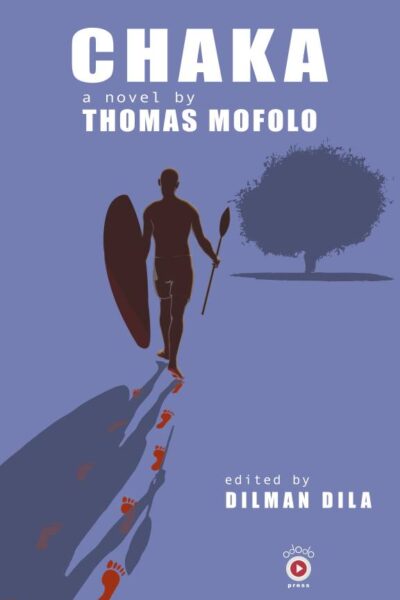
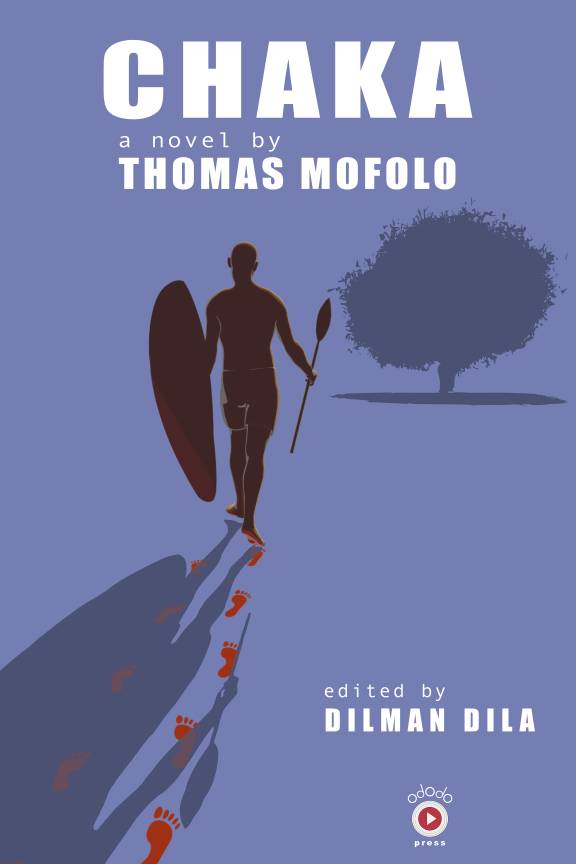
Chaka
Thomas Mofolo, Dilman Dila (editor)
Novel | 65k words | about 200 pages
Genres: Dark Fantasy, Horror, Folk Tales
Release Date: 1 July 2026:
Click Here To Pre-Order

Price $7 UGX 15,000 100% Discount
To get this e-book for free, subscribe to our newsletter. If you are already a subscriber, check your email. We sent the link on 1st September 2026. Click here for more free books.
The print version is available only on demand. Send us an email to contact@ododopress.com to place an order. The price will vary depending on what the print-on-demand facility charges at that time, but so far this has been it: US $25 | UGX 80,000
Add about $20 for international shipping. If purchasing within Kampala, you will cater for the bodaboda guy.
Price: $7.00
Blurb
This short novel is a folk history of Shaka Zulu, documenting what ordinary folk were saying on the rise and fall of the legend, about a hundred years after his reign. It is a dark fantasy story.
Product Details
Publisher Ododo Press
Publish Date 1st Sept 2026
Pages About 200 pages
Word Count About 65,000
Language English
Type e-book (pdf, epub, mobi), AudioBook (not available), Print (paperback, available on demand)
ISBN:
Categories: Dark Fantasy, Horror, Sword-and-Sorcery
About the Author
Thomas Mofolo, born about 1875, was from Lesotho, and wrote in Sesuto. He worked as a teacher in the Maseru mission school and also as a clerk and proof-reader at the joint offices of the Morija Book Depot and the Morija Printing Works, where the Leselinyana, the oldest Sesuto paper at that time, was published, and where he began his career as a writer. In 1906 the Leselinyana serialized his first book ‘Moeti oa Bochabela’ (“The Pilgrim of the East”). After this followed ‘Pitseng’ (‘At the Pot’ – the name of a village in a hollow). “Chaka” was his third book, and the most famous.
Chapter One: Nandi Chooses Senzangakona As Her Lover
The country of South Africa is a large peninsula lying between two oceans, one to the east and one to the west of it. Its inhabitants belong to many and various nations speaking different languages, yet they all fall easily into three main divisions. The nations along the western sea-board are the San and Khoekhoe; the midland nations are Lesotho and Botswana, and the eastern people include the Matebele. The boundaries between them are broad and clear, for they are natural and not made by man. The western people are separated from the midlanders by wide waterless sandy wastes, and the midlanders are divided from the eastern nations by a great range of lofty mountains which, beginning in Cape Colony, runs in a northerly direction parallel to the sea but at some distance from it. The differences are so striking that any one travelling from west to east feels them at once, and when they arrive among Basotho they realize again that they have come into a different country and among different people. They feel the difference further when they cross the mountains and comes down among the Matebele living on the other side.
Our story is concerned with the eastern nations, and before we begin it we must describe their state in the early days, so that the reader may be able to follow the narrative in the succeeding chapters.
The greater part of their land lies between the mountains and the sea and is covered with dense bush; hard frosts are unknown, for owing to its nearness to the sea there is never more than a slight touch of frost. It is a green country with luscious grazing, and the soil is a rich clay: this tells us that the crops are large. Its grasses are the ‘seboku’ and the ‘tlanyane’ and water stands in the valleys: this tells us that the cattle there are fat. The rivers are numerous: this tells us that there is plenty of rain. It is a land of mists which do not disperse till the sun is high: this tells us that there are no droughts and that the moisture remains long in the ground.
In the early days when South Africa was first inhabited there was no part so thickly populated as the eastern part, for the villages there were both large and numerous. The people in the east surpassed all the others in South Africa in their traditional knowledge of medicines, for they belonged to the country where medicines abound. Medicines for bewitchment, for enchantment, for murder, for fascination, for scattering one’s enemies, for making oneself to be loved by people – in using these they were without rivals. Even the San, so famed for their knowledge of poisons, could not approach them. They were also famous for being able to converse with those who had died long before, and to receive advice from their spirits.
Water-snakes are held in great reverence in this land, and not only water-snakes but also the smaller reptiles such as the cobra, puff-adder, and others. If a person sees a snake it is a serious event foretelling either good luck or misfortune and punishment coming to them by the spirits of their ancestors. (No snakes are killed in this land, for whoever kills a snake commits a heinous crime and carries the shame of it all the days of their life. It is said that by this act they have cursed their ancestors and shamed them by killing their messenger. For in this land the snake is a well-recognized messenger bringing tidings from the dead to their descendants.)
If a snake enters a hut while the owners are absent they will not enter again while it is there, but will sit outside until it comes out of its own accord: they think that one of their ancestors is pining for their society. Again, if a snake enters a hut where some event or other has recently taken place, it is said that the spirits have been angered or grieved at the acts of their descendants and will visit them with fearful punishments, such as disease or an attack by their enemies. The moment a snake enters a hut the owners give thanks to it or pray its pardon and beg for mercy from the angered spirits. Thus there are many snakes in this land, for they are never killed. It will be easily understood that a snake will be a part of every medicine in this land; it would be impossible to omit an ingredient of such potency.
The first eastern nation a person meets when they come down from the north between the mountains and the sea, going towards Delagoa Bay, is that of the Maswazi. On the other side of the Black Umfolosi are the Undwana, formerly ruled by Zwide. Between the Black and the White Umfolosi, as far as the sea, dwelt the AbaTetwa, ruled by Jobe, or rather by his son Dingiswayo for he was more famous than his father. Between these two rivers, but a little higher up, dwelt a small weak nation, the Ifenilenja, subordinate to Jobe. This was the nation that in later times became so famous that all other people in the eastern parts were called by its name, Zulu. Near them were the Amangwana of inkosi Matiwane (the Mankwane of Matowana who besieged Thaba Bosiu) and also the Amaqabe, Amafunze, Abatembu, Amakunze, Amahlubi, Abakwamacibise and the Amatuli (these last dwelt where the town called Durban is situated today). The reader must understand that we are speaking of the positions of these nations long ago, when the land was first inhabited. The many weak nations on the banks of the White Umfolosi had fled to Jobe, inkosi of the Abatetwa, and begged for his protection, for he was a man of mercy, and among them one was this small nation of the Ifenilenja (Amazulu). In those days the Amazulu were the weakest of all; they were allowed to live only by the mercy and good-will of the great inkosi Jobe. The only thing they were famous for was the selling of snuff, clay pots, wooden dishes and things of that sort.
There is no country in the world where wars do not take place. At one time or another people quarrel and prepare to fight: sometimes they fight for years, but in the end peace returns again and the country prospers once more. Sometimes when the nations are dwelling in peace a male child is born to an inkosi in a certain country and that inkosi’s son is enough to cause disturbances in that land, so that peace departs from the earth and he spills the blood of many though he be but one. But such slaughter as was seen in the “great wars” was a thing not known in the days of old, when the country was first inhabited. The nations were living in peace, each in its own habitation where it had been placed when Unkulunkulu brought human beings out from the reed-bed. In that time of profound peace and prosperity there was no one who thought for a moment that the time was close at hand when their life would be utterly transformed or that one day they would wander over the land without any fixed abode, killed by hunger and thirst while in flight.
The little nation of the Mazulu was in those days ruled by Senzangakona. He was still quite a young man and had three or four wives, but in all his huts there was not a single male child: there were only girls. He grieved for this and his heart was sore, for in Ifenilenja to be without an heir is a more distressful thing for the inkosi than for the common person, for a leader deplores the fact that the possessions of his house, his ubukhosi (reign), his country, and his people may be without an heir. In these circumstances Senzangakona therefore meditated marrying another wife, a junior one, who might provide him with boy children. Accordingly he caused a great feast and dance to be held, and during it he looked about secretly to see if there was any young girl who would take his fancy. Of the girls who came to the feast the one who pleased him most was Umnandi or Nandi, the pleasant one, a girl of Langeni’s who was living at Qube in Senzangakona’s country. Nandi was a great performer at songs and dances, skilled at clapping hands when the boys danced and at joining in the chorus when they sang. She was a tall upstanding girl, round and ruddy-golden in the face, with a nicely coloured skin and a plump body: she was a person who ‘cast a shadow’ – so much so that many would say that her beauty was due to her shadow (personality).
When the dancing and games were over beer was produced, and while people were drinking a party of boys went over to the girls and asked them to play ‘Kana’, and when Senzangakona saw them he made haste so that he might be present at the game. Nandi had already noticed what was in Senzangakona’s mind and that he wanted her to choose him for her ‘Kana’. To ‘kana’ is something like the Seliea-liea of Basotho (‘Choose-the-one-you-love-the-best’), but in some respects it is more like choosing a lover. Nandi was in love with Senzangakona so she chose him, and Senzangakona was very glad to be chosen by the one he loved.
When the feast was at an end and the men and women had scattered to their homes the young people spent the night in games at Senzangakona’s village and left early in the morning of the next day. Senzangakona told the maidens from Qube to wait for him in the hollow below his village among the fields. And there he tried his utmost to make Nandi do what is forbidden by law and common consent, until Nandi went away and left him alone in the fields. She was very sad when she found that the man whom she had chosen as her ‘kana’ did not love her with a pure love, and when she came up to the other girls she told them what Senzangakona had said to her.
In those days in Ifenilenja, an unmarried girl who bore a child was put to death and her boy and girl companions were put to death as well, that is to say all who slept in the same huts. It was said that the whole group must have known of her act when she committed it, and that they would corrupt the younger generation by teaching them bad habits.
The other girls were very sad when they heard of Senzangakona’s evil designs. None the less they were afraid to make them known, because among the eastern people the inkosi is above the law. But in justice such designs of a young man ought to be made known at once, so that he alone may suffer death and his companions escape. But Senzangakona hoodwinked them with deceitful speeches and promises that he would marry Nandi and in the end he took her by force and accomplished the evil desire of his heart.
When Nandi saw that her time had come she informed Senzangakona and he made hurried preparations to marry her for fear of the disgrace. He gave her parents fifty-five head of cattle and took her to his village quickly before people could notice her condition; but all the same Nandi was pregnant when she went to Senzangakona. When the time of her delivery approached Senzangakona sent Nandi back to her home, where she gave birth to a boy child, such as Senzangakona had longed and hoped for night and day, and his joy was full and overflowing. The messenger who announced the event to Senzangakona said ‘A boy child is born to you, an ox to feed the vultures.’ And indeed there never was a boy to whom these words could have more truly been applied. He was indeed a man child, in every sense an ox to feed the vultures, as the reader will see later.
Senzangakona sent a message that very day to Jobe, his inkosi, or leader, to inform him that he had now a herdboy who would tend his cattle, who would fight his battles for him and succeed him as inkosi, and we shall see how much these words of Senzangakona’s influenced events. On his arrival at Jobe’s court the messenger found Jobe’s sons there and he delivered the message in their hearing. When he had ended Jobe said: “Go, tell your master that I rejoice with him. May the child grow and wax strong and become a man indeed. So it is, Godongwana (Dingiswayo), he of whom we hear today shall be your vassal. He will fight your battles, not mine, for I am old. I shall be no longer here when he reaches manhood.” Jobe showed by his words that he knew what the child would become in the world and he judged aright in handing the matter over to his sons.
The boy was given the name Chaka by his father, and when the month of purification was over, he ordered Nandi to bring the child to him so that he might see and know him. And afterwards Nandi returned to her home with the babe Chaka to shield him from ubuthakathi, for it had been said that it was owing to witchcraft that wives of Senzangakona were unable to bear male children.
Nothing here yet
Similar Books


eBook $7
Pre-Order
.mobi .epub .pdf
Price: $7.00