Finally all set to release this book, Myths and Legends of the Bantu and Other Africans, by the 1st of August. I will initially give it for free to subscribers of our newsletter, so be sure to sign up. It’s an important book, for it is a documentation of African cultures that are today largely forgotten, or lost to time. I’ve revised and edited the book, getting rid of misogynistic and bigoted ideas, and also very racist and problematic portrayals of Africans, and so in these pages you get a clean portal into old worlds, new creatures, and very diverse stories and characters.
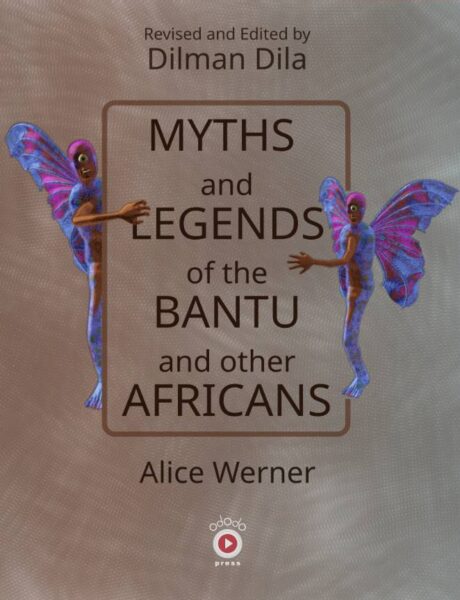
I had already shared an earlier version of the cover, but since I made a major change, and since I had not done a ‘cover reveal’ post before, well, here is one. I took inspiration for the art from one of the things that blew me away when reading it the first time, the thing that prompted me to revise and edit the book for a modern audience. This kind of lore is, to the best of my knowledge, lost to time. At least I had not heard of half-people in African mythology until I came across them in these pages. They fascinate me. Perhaps soon such a creature will feature in one of my stories.
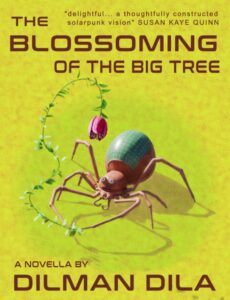
The Blossoming of the Big Tree
Dilman Dila
eBook $7 | UGX 15k
“…delightful — wonderful worldbuilding with a thoughtfully-constructed solarpunk vision as well as a compelling story that hooks you in!”
“…delightful — wonderful worldbuilding with a thoughtfully-constructed solarpunk vision as well as a compelling story that hooks you in!”
eBook $7 | UGX 15k
After I shared the first version, someone commented that the creatures had bat wings, and it disturbed me, for imagining people with bat wings is clearly an influence of present-day pop-culture, most likely with origins in European tales of the vampire (re: Dracula), but especially given the batman universe. The half-people described in the Myths and Legends of the Bantu are very far from bats. An example are the mangabangabana, which is the name I’d give to the cover artwork if I were a pretentious artist, and they are from the mythology of the Baronga. They are said to be one-legged, and they perhaps have wings, or just the ability to fly, but I depicted them with wings since I wanted to quickly convey the idea of flight. And in this version, I changed the wings to something less bat-like. It looks more like a moth’s wings.
That also influenced the decision to give them color, since moths love their colors. I know, there’s still a lot of moth-people in popular culture today, the most famous being Mothman from American folklore. but well, it’s not as in-your-face as bat-people, and giving my creatures these vibrant colors would perhaps differentiate them from Mothman, who is often depicted in dark and grim colors.
On another look, the colorfulness might indicate something straight out of Disney, but well, I don’t think these kinds of creatures could make it to the realms of the Disney princess! The one eye (which I made bigger for it was kind of lost in the previous version) might also be redolent of cyclops, with the Odyssey being in the news now, but this is perhaps a reminder that certain tropes are universal and should not be associated with only one culture or place.
There is a certain difficulty in imagining very unique creatures, for our imagination is shaped by what we have grown up consuming. The creatures I encounter in the myths and legends of Africans are very unique, and perhaps a visual artist with better talent than I can ever master, and with better imagination, will come up with a depiction that will do justice to these ideas. For now, well, let’s go with what I came up with.
I modeled the character in Blender, using a base mesh from the MakeHuman addon, and I used the Manga Shader for Blender, by Paul Caggegi, to give it a stylized look. I used Krita to come up with the background, and did the final designs for the cover in Inkscape, which has of recent become my favorite design tool.
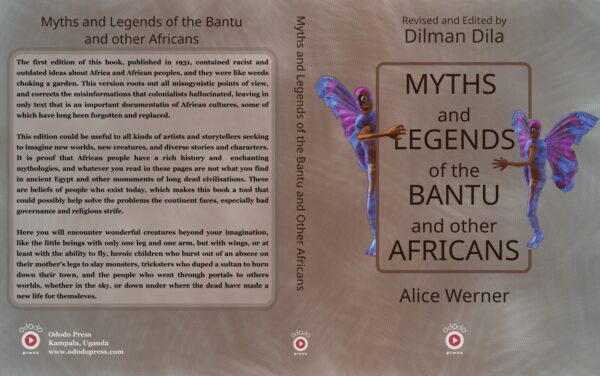
The back cover blurb
The first edition of this book, published in 1931, contained racist and outdated ideas about Africa and African peoples, and they were like weeds choking a garden. This version roots out all misogynistic points of view, and corrects the misinformations that colonialists hallucinated, leaving in only text that is an important documentatin of African cultures, some of which have long been forgotten and replaced.
This edition could be useful to all kinds of artists and storytellers seeking to imagine new worlds, new creatures, and diverse stories and characters. It is proof that African people have a rich history and enchanting mythologies, and whatever you read in these pages are not what you find in ancient Egypt and other monuments of long dead civilisations. These are beliefs of people who exist today, which makes this book a tool that could possibly help solve the problems the continent faces, especially bad governance and religious strife.
Here you will encounter wonderful creatures beyond your imagination, like the little beings with only one leg and one arm, but with wings, or at least with the ability to fly, heroic children who burst out of an absece on their mother’s legs to slay monsters, tricksters who duped a sultan to burn down their town, and the people who went through portals to others worlds, whether in the sky, or down under where the dead have made a new life for themsleves.
Similar Books